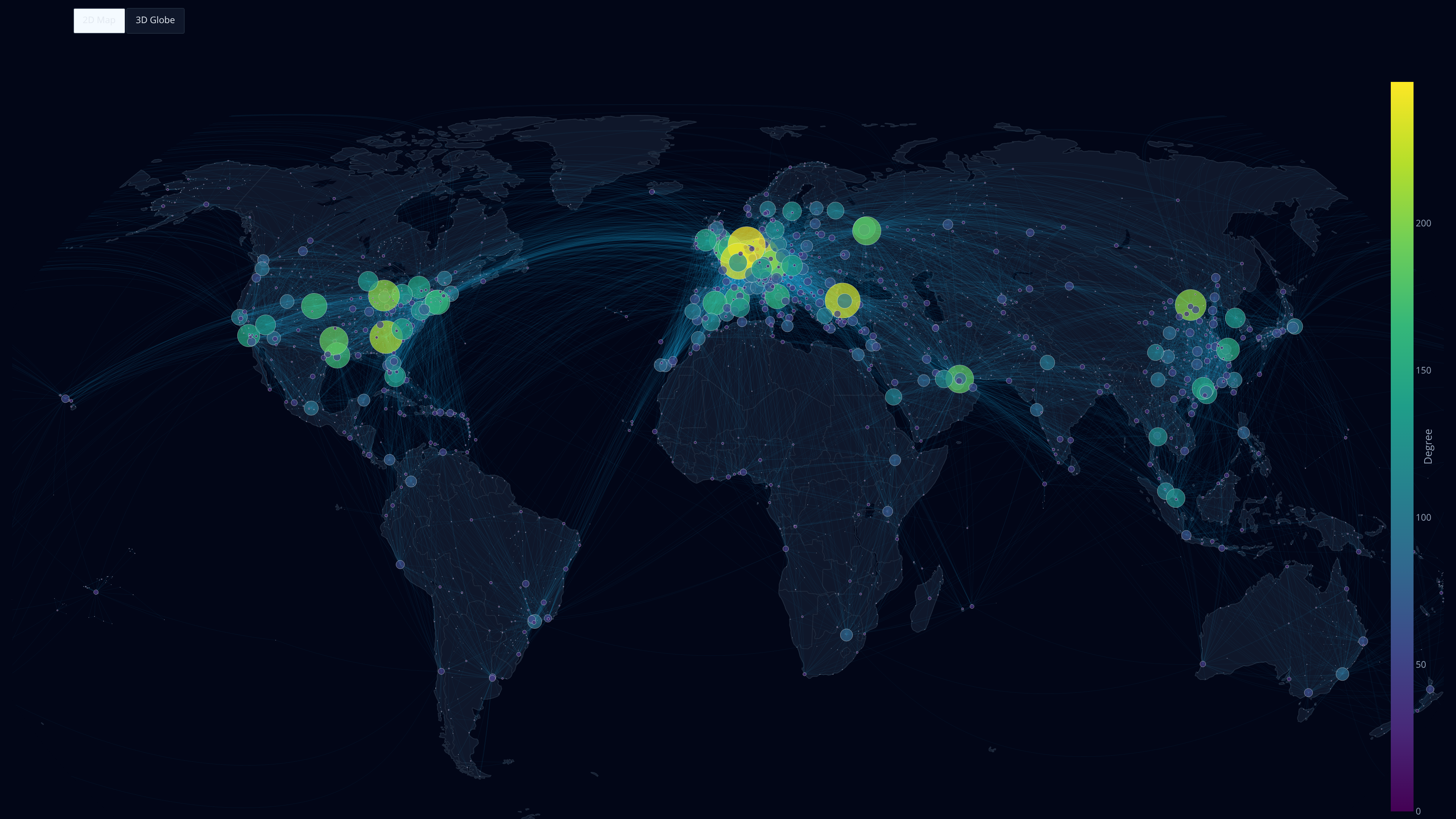
Complete 2D and 3D visualization of the network. Each node represents an airport and each edge represents an active commercial route.
A topological study of the worldwide air transportation infrastructure using graph theory, community detection algorithms, and interactive scientific visualization.
Complete 2D and 3D visualization of the network. Each node represents an airport and each edge represents an active commercial route.
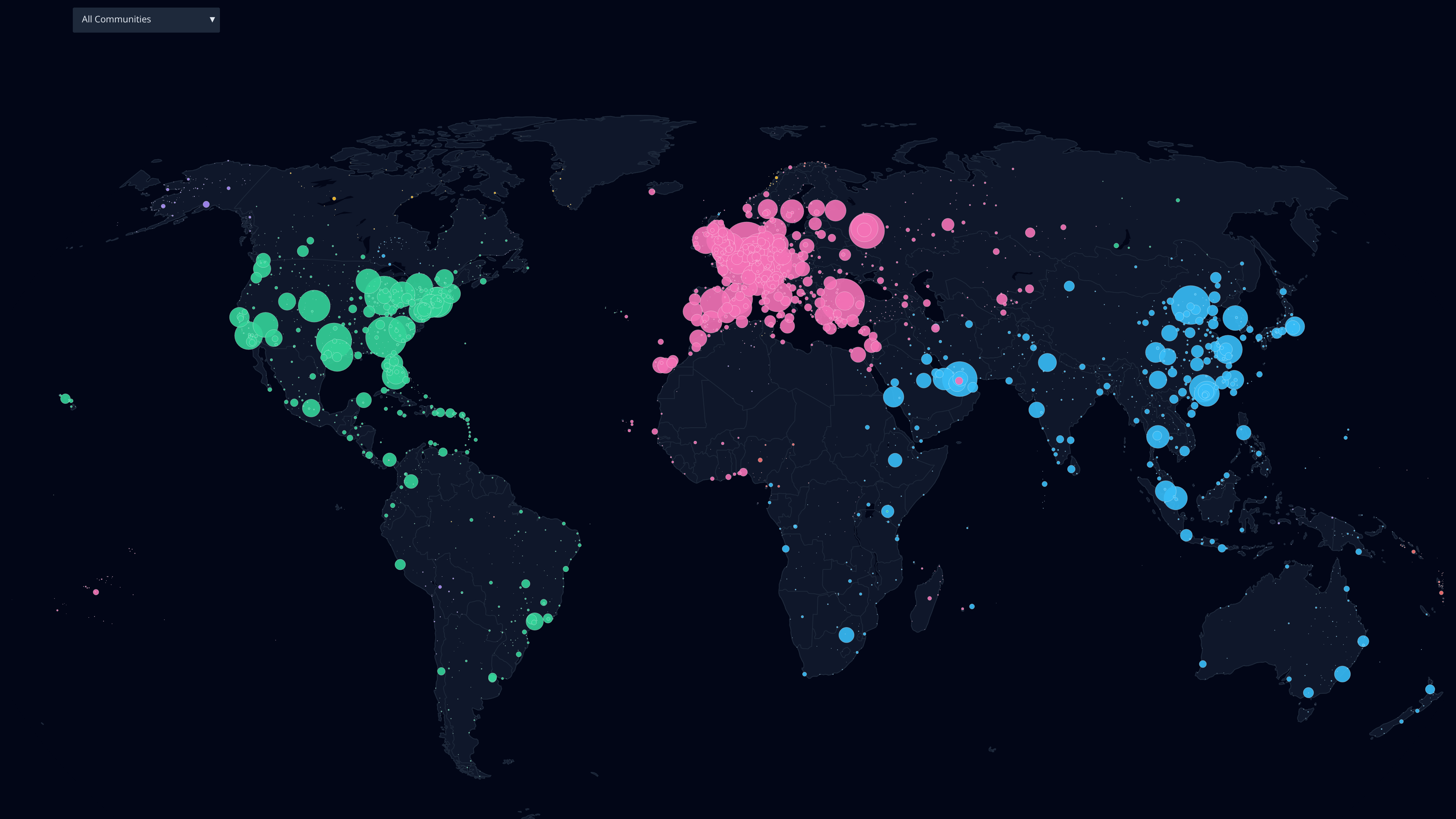
Application of the Clauset-Newman-Moore modularity algorithm to detect communities. Colors cluster airports that are highly connected to each other.
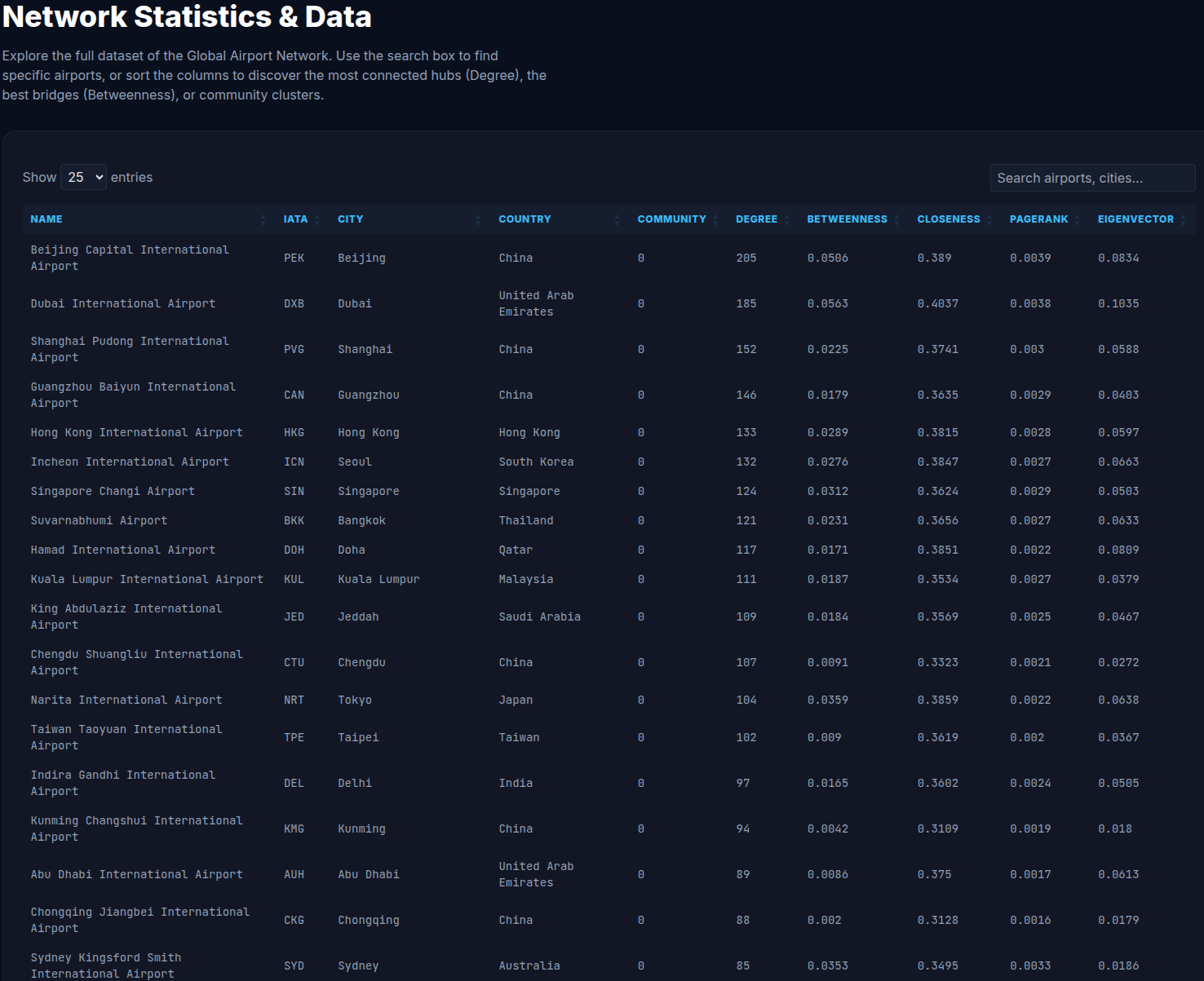
Explore the full dataset of the Global Airport Network. Use the search box to find specific airports, or sort the columns to discover the most connected hubs (Degree), the best bridges (Betweenness), or community clusters.
This research project investigates the global airport network as a complex system, applying graph theory and network science methodologies to understand the structure and organization of worldwide air transportation.
The network is modeled as an undirected graph where nodes represent airports and edges represent the existence of at least one air route between two airports, regardless of direction. This approach allows us to focus on the fundamental connectivity structure of the aviation network.
The visualizations provided on this website allow researchers and aviation enthusiasts to interact with the data, explore connectivity patterns, and gain insights into the complex structure of global air transportation. The data has been extracted from OpenFlights.